Pre‑16th century → 19th century
Bantu • Yoruba/Fon • Kongo traditions
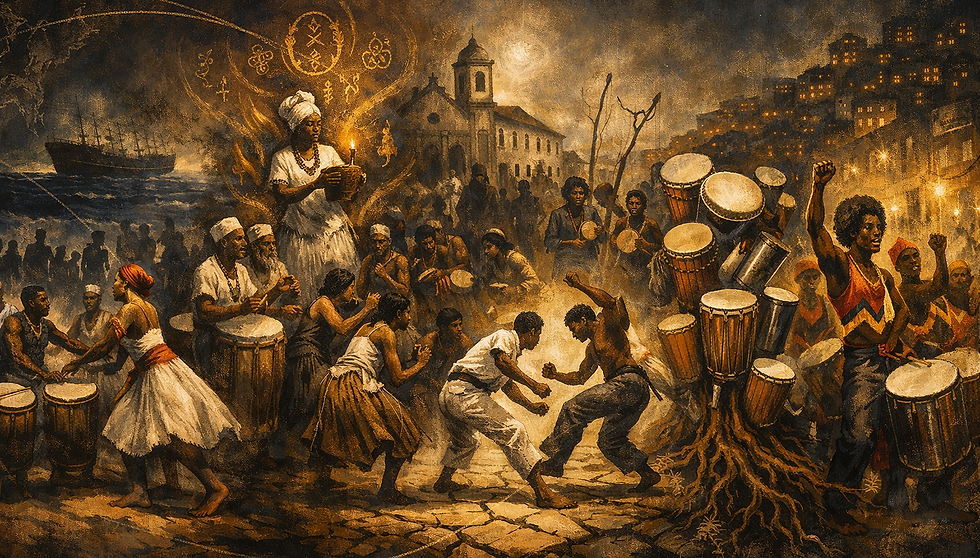
Long before Brazil, these rhythmic systems shaped daily life, spirituality, and community across Central and West Africa. Bantu semba dance, Kongo call‑and‑response, and Yoruba/Fon sacred drumming travelled across the Atlantic in the memories of enslaved peoples, becoming the foundational pulse of Afro‑Brazilian music.
16th–19th centuries
Candomblé • Batuque • Capoeira
Under slavery in Brazil, African rhythms survived through ritual and resistance. Candomblé ceremonies preserved Yoruba and Fon drumming, batuque gatherings kept communal dance alive despite bans, and capoeira evolved as a disguised form of resistance, blending movement, rhythm and defiance.
19th–20th centuries
Samba de roda • Carnival percussion
After abolition in 1888, Afro‑Brazilian communities continued shaping Brazil’s musical identity. Circle dances, hand‑clapping and percussion from batuque transformed into samba de roda in Bahia, while street processions and Carnival ensembles amplified African‑derived rhythms into public celebration.
1970s
Black Pride in Bahia
In the 1970s, Afro‑Brazilian youth and cultural groups reclaimed African heritage as a source of pride and political power. Afro blocos emerged in Salvador, using drums, dance and public performance to confront racism and affirm Black identity.
Late 1970s → Present
A fusion of African memory, Brazilian struggle, and diasporic rhythm
Samba Reggae was born from Afro blocos blending samba, reggae, Candomblé rhythms and African percussion traditions. It became a musical innovation and a political statement, a sound that honours ancestral memory, confronts inequality and connects Afro‑Brazilian communities to the wider African diaspora.